Wholesale & Trade / October 1, 2026
MOQ, Case Quantity, and Order Minimum: What Small Gift Shops Should Check
By Rock Paper Scissors
Separate product minimums, case quantities and order-value thresholds. Use a worked cart example and a practical checklist for small gift shops.
Shop Rock Paper Scissors on Faire
Article guide
Check three separate limits: how many units of a product you must buy, which pack sizes you must order, and the minimum value of the whole order. A cart can satisfy one and fail another. For a small gift shop, the practical question is whether the resulting quantities fit the display, storage and buying plan.
Faire’s minimum-order-quantity documentation distinguishes a product’s required quantity from an order minimum. Its retailer guide to wholesale minimums explains the difference between unit and order-value constraints. Suppliers and channels can present terms differently, so use the exact product and current cart for the values that apply.
Three terms, three questions
| Term | What to establish | Question for the supplier |
|---|---|---|
| Minimum order quantity, or MOQ | The lowest allowed quantity for the specified product or grouping | Does this apply per design, per option, or across the listed product? |
| Case quantity | How many individually sellable units are in one case, and which multiples can be ordered | Can I mix designs or sizes, or must each case match? |
| Order minimum | The required value of the cart from that supplier | Do opening and reorder minimums differ, and what counts toward the threshold? |
Do not infer an answer from the word “pack” alone. Confirm what arrives and how it is counted: one coordinated product containing several pieces can be different from a wholesale case containing several separately sellable products.
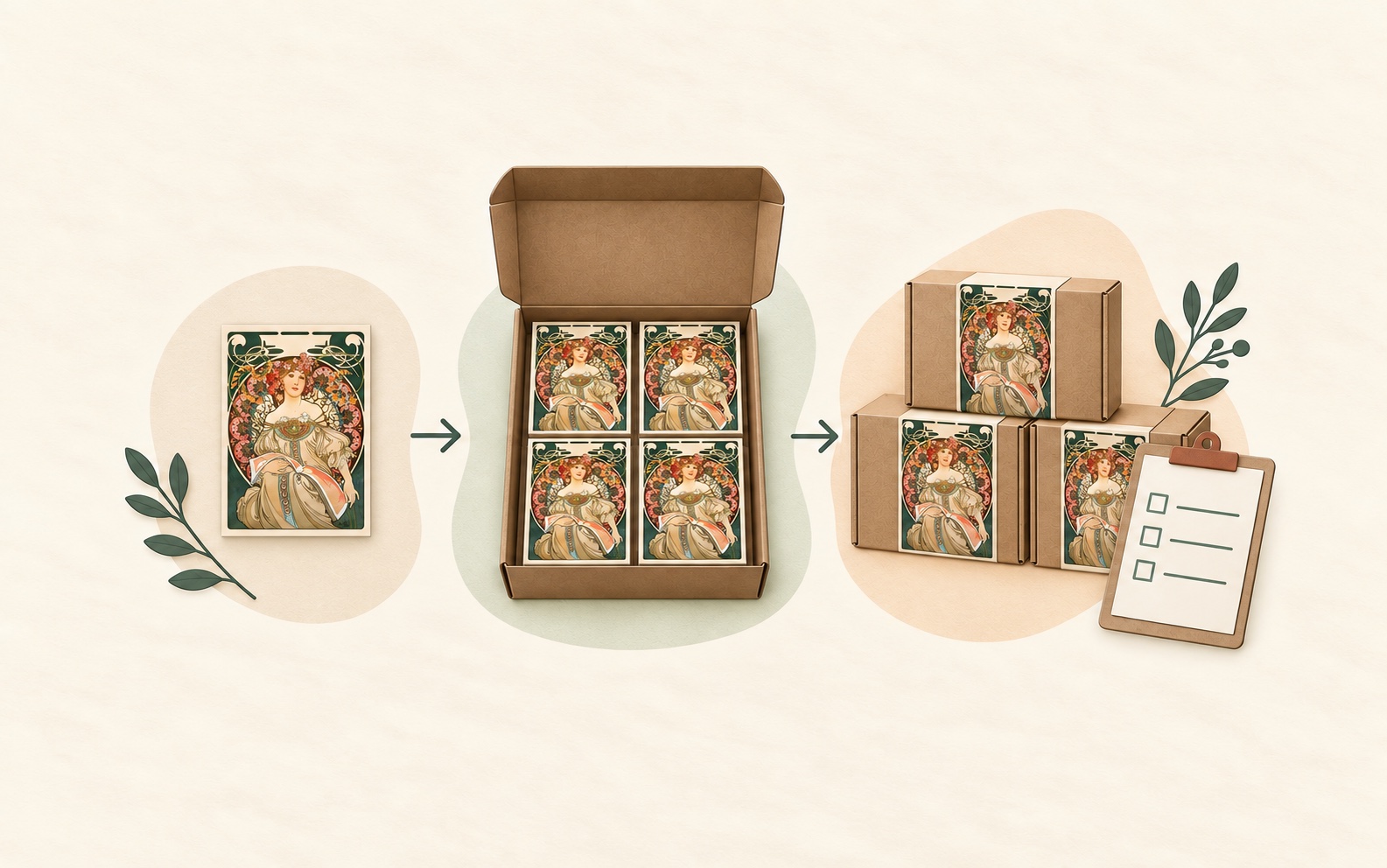
A worked cart that passes two checks and fails one
Here is a hypothetical supplier, not RPS or Faire pricing: each print costs $8, the case size is four matching prints, the product MOQ is four, and the order minimum is $100.
- One case each of three designs contains 12 prints and costs $96 before any other charges. It meets the stated product and case constraints but misses the $100 order minimum.
- Adding one loose print would bring the product subtotal to $104, but is not an allowed solution if the supplier only accepts complete cases.
- Adding one more case brings the cart to 16 prints and $128. That meets the example’s rules, but now the store needs a place for four more units.
The lesson is to calculate the allowed cart, then assess whether you want that cart. Do not treat crossing a threshold as a reason to buy unwanted stock. Ask about available alternatives before assuming that a special case mix or smaller order is possible.
Check what the minimum actually includes
Record the currency and whether the displayed threshold uses merchandise value before or after discounts, and whether tax or shipping contributes. Check opening-order and reorder terms separately. If the account screen is unclear, ask the supplier rather than building a plan from a general article.
The same caution applies to options. A portrait and landscape version, a second size, or a different design may be counted separately. Write down the current rule you verified, along with the channel and date, so someone else can reproduce the cart.
Translate the cart into a store plan
For each allowed case, name the display position and reserve location. If four matching units mean one on display and three in storage, record both. If the whole case will be displayed, check that the fixture can hold the actual packaged dimensions without bending corners or hiding neighboring designs.
Use the width-versus-depth guide to decide whether an additional case supports a proven design or merely makes the total work. The display-capacity budget helps connect those units to the space they will occupy.
Keep the final check in the ordering channel
- Exact design, size and sellable unit identified.
- Minimum quantity and case multiple reproduced in the cart.
- Opening or reorder threshold checked for this account.
- Current costs, delivery estimate and applicable terms reviewed.
- Every resulting unit assigned a display or storage location.
- Any exception confirmed before checkout.
For RPS, start with the wholesale ordering overview or the Rock Paper Scissors Faire shop, and use the current listing and account details. Our supplier-question checklist covers the product and receiving questions that remain after the quantities make sense.